In Part 2 (of 2), author-designer Mark Voger talks about his latest book “Futuristic: Rockets, Robots and Rayguns of Space Age Pop Culture” (TwoMorrows Publishing). Order “Futuristic” from TwoMorrows, Barnes & Noble and Amazon, among many outlets.
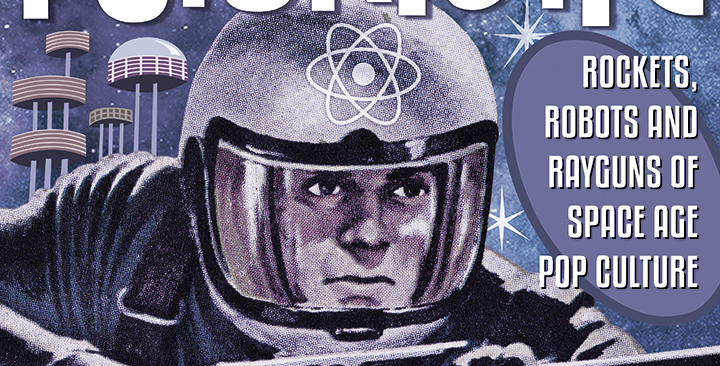
Q: You reference three distinct “futures” that were depicted during the Space Age, which you call “utopian ease,” “populace-squashing autocracy,” and “total nuclear destruction.” It seems to tend toward the bleak. Was there no hope?
A: The hope for a utopian future as depicted in then-contemporary entertainment — that was fantasy. In real life, hope manifested itself in what we came to call “post-war optimism.” Guys from my father’s generation — he was a Marine during World War II — were happy just to get home in one piece, if they were so lucky, and marry, make a living, raise a family. After witnessing the horrors of war, that was utopia. As regards fear, once the potential for global destruction was introduced in real life with the bombings of Hiroshima and Nagasaki, the fear of same was exploited by men like Joseph McCarthy and Nikita Khrushchev, ostensible adversaries who sought the same thing: power.
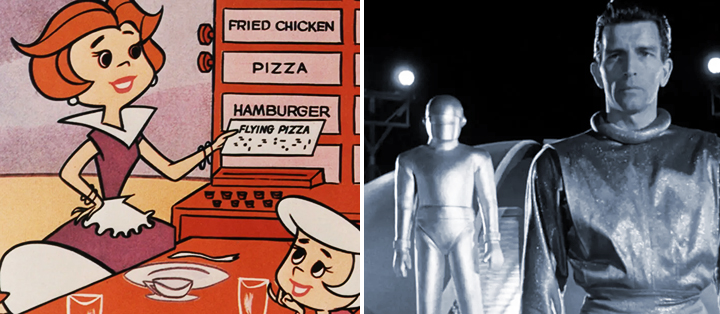
Q: You note that during the Space Age, people could subscribe to wholly different futures — “Tom Corbett: Space Cadet” and “The Jetsons” vs. the more adult science-fiction films.
A: “Corbett,” of course, was a Western with space helmets instead of cowboy hats. “The Jetsons” was a satire of suburbia much like its predecessor, “The Flintstones.” They’re just entertainment, though both were prescient. Something resembling Tom Corbett’s space helmet was worn by Neil Armstrong during the 1969 moon landing. And everything in “The Jetsons” came true except the flying cars — so far. As for the adult-oriented sci-fi movies, they were hardly monolithic. Howard Hawks’ “The Thing From Another World” (1951) was alarmist and militaristic, an us-vs.-them story in which the sole alien (James Arness) was a metaphor for America’s antagonists. The two films that got it right, that should be compulsory viewing, are Robert Wise’s “The Day the Earth Stood Still” (1951) and Don Siegel’s “Invasion of the Body Snatchers” (1956). In the former, the alien played by Michael Rennie is a Christ figure. The latter lays bare the Red Scare, despite the denials of its makers. Both films warn against the consequences of panic and “othering.”
Q: There are a lot of toy robots, comic books and other collectibles in “Futuristic.” Were these your introduction to futurist thinking?
A: The first thing that got me thinking about life in the future was “Lost in Space,” the Sixties TV series. I was 7 when I saw the pilot episode, and I grasped that I was watching a show set in 1997, yet I was in 1965. I knew it was “make believe,” but at the same time, I kind of thought, “This is the way things will be in 1997.” I was that young. For kids of my generation, playing with toy robots or reading sci-fi comics definitely got our imaginations churning and, thinking back, left an impression on our subconscious. Thereafter, with each little leap in technology — the microwave oven springs to mind — we would marvel and say, “This is the future!”
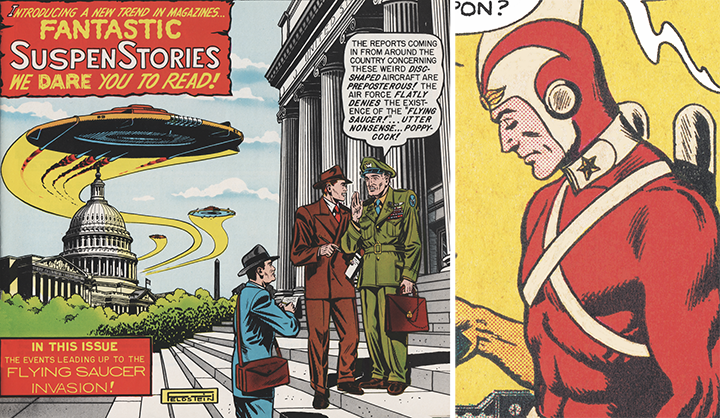
Q: On the subject of comics, you spoke with William Gaines and Julius Schwartz, two of the most influential figures in sci-fi comics. What did you learn from them?
A: They taught me that passion for the subject matter was the impetus. Those guys were voracious readers of the sci-fi pulps who went on to become the biggest boosters of science fiction in comics. Gaines published sci-fi comics even though they lost money for his company, Entertaining Comics. During a time of social paranoia, EC’s stories snuck in progressive themes. Schwartz was influential in the creation of sci-fi fandom — he was among the founders of the first-ever science fiction convention in 1939 — and was a literary agent representing sci-fi authors before taking a job as a comic book editor. To Schwartz, the word “science” in the phrase “science fiction” was of uppermost importance. The comics he edited were, for better or worse, like a science class. Julie held that solid science makes the fiction believable.
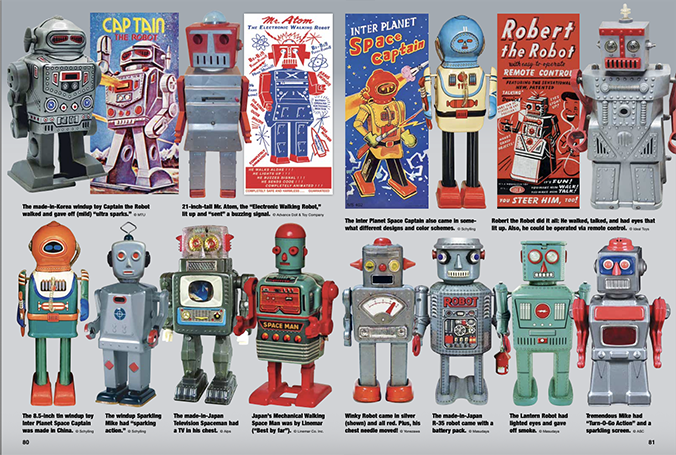
Q: Considering the visual design of “Futuristic,” were you trying to point readers in a certain direction?
A: Thank you for commenting on the design. I’m not looking for a particular response. It’s more like I drop all of this visual information into your lap and ask, “What do you think?” Many people from my time — I’m 67 — dig the sheer nostalgia of it. But my hope, and perhaps it’s a naive one, is that younger people may see these crazy little Japanese toy robots and go, “What the hell is that?” Further exploration on their part would be, for me, a dream come true.
Q: Do you see parallels between contemporary futurist thinking and that of the Space Age?
A: I struggle with this question for a mundane reason: I’m a dinosaur. You hear about older people who don’t have smart phones and don’t avail themselves of apps? That’s me. Even the programs I work in to produce books grow increasingly old-hat with each passing year. Why spend a day perfecting an image in Photoshop when AI can do it in a nanosecond? InDesign is used to create print publications, while print remains in the throes of a slow, painful death. All that aside, I fear our conflicted visions of the future in today’s cultural moment are the result of disinformation. Everyone is living in their own reality. The only glimmer of insight I have for you is that while pulling (the book) “Futuristic” together, it became clear to me that certain dystopian-future movies are practically documentaries, and George Orwell was a prophet.
ORDER “FUTURISTIC”: TwoMorrows | Barnes & Noble | Amazon | Walmart
SEE Mark Voger interview with Conskipper HERE
SEE “Futuristic” reviewed in Psychobabble HERE
SEE “Futuristic” reviewed in The Imaginative Conservative HERE
SEE 13th Dimension preview HERE