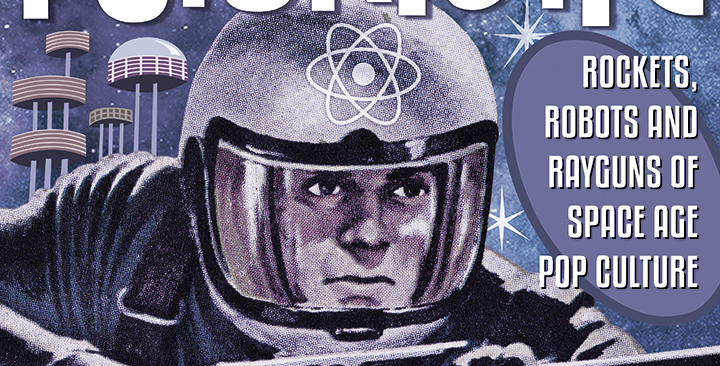
Author-designer Mark Voger talks about his latest book “Futuristic: Rockets, Robots and Rayguns of Space Age Pop Culture” (TwoMorrows Publishing). Order “Futuristic” from TwoMorrows, Barnes & Noble and Amazon, among many outlets.
Q: Is there a timely reason for a book about the Space Age?
A: With the advance of AI, it feels again like we’re living in the future, which is kind of how people felt during the Space Age. But AI is a job-gobbler in a terrible economy, so this future is more dystopian than utopian. Much of George Orwell’s “1984” has come true. Everything in “The Jetsons” came true except the flying cars. Give them time.
Q: Regarding the Space Age era in America, what years are we talking about?
A: “Futuristic” focuses on 1945 through 1969. The world changed irrevokably in 1945 when the U.S. dropped atom bombs on Hiroshima and Nagasaki, which ended World War II but at a terrible cost. Anxiety over atomic and nuclear weapons — who’s got them now? who might use them next? — dominated the zeitgeist over the next few decades. This triggered a period of social paranoia that saw the Cold War, the Red Scare, Sputnik, the Space Race, the UFO Craze, and tons of sci-fi media. In 1969, science fact caught up with science fiction with the first moon landing.
Q: That all sounds heavy for a pop culture book.
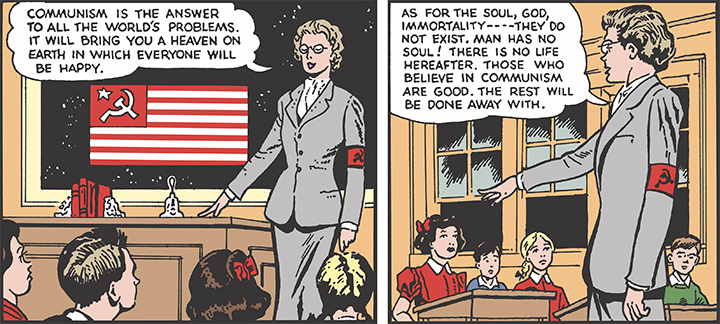
A: It is, but that’s what makes the Space Age so fascinating. The so-called “post-war optimism” of the late Forties and Fifties was all about: “In the future, we’ll be living lives of utopian ease!” Meanwhile, we had duck-and-cover drills and comic books which filled readers’ heads with scenarios of total nuclear destruction. It was a hand grenade baked into a fluffy pie.
Q: Is “Futuristic” political?
A: At heart, “Futuristic” is a book about popular entertainment. It covers movies, TV, comic books, trading cards, action figures, games. It celebrates “Tom Corbett: Space Cadet” and “Fireball XL5” and “Lost in Space” and the original “Star Trek” and adorable little Japanese toy robots. But politics are unavoidable. Some of the period’s best sci-fi movies — “The Day the Earth Stood Still” (1951), “Invasion of the Body Snatchers” (1956), “Dr. Strangelove” (1964) — boldly took positions, expressing them through art. The same can be said for an earlier sci-fi film, Fritz Lang’s silent masterpiece “Metropolis” (1927). Check it out.
Q: Who do you interview in “Futuristic”?
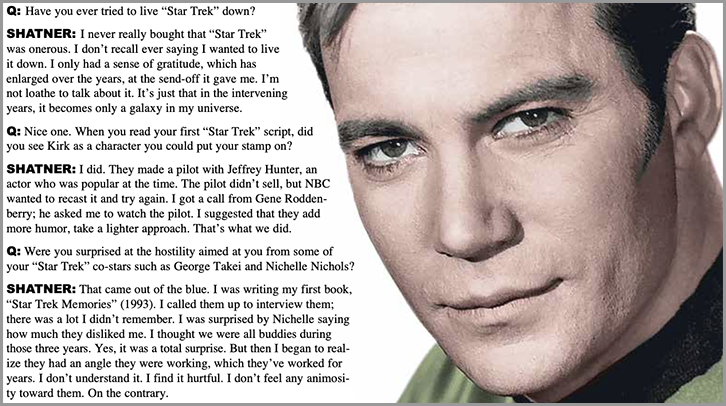
A: I’ve been interrogating pop culture creators since the Eighties. In “Futuristic,” I present my conversations with Jonathan Harris, Bill Mumy (“Lost in Space”); William Shatner, James Doohan (“Star Trek”); Kevin McCarthy (“Invasion of the Body Snatchers”); Kenneth Toby (“The Thing From Another World”); William Gaines (EC Comics sci-fi); Julius Schwartz (DC Comics’ sci-fi); and others.
Q: What did they tell you?
A: Two things stand out. One has Jonathan Harris explaining how he “slyly” introduced the character of the conniving Dr. Smith into “Lost in Space.” The other is a friendly debate with Kevin McCarthy over whether “Invasion of the Body Snatchers” was an allegory for the Cold War. He said no, and he ought to know. When I then said, “You stick to your theory and I’ll stick to mine,” I found his reply to be so gracious. He said: “But that’s OK. Nothing wrong with that. What you see in the painting may be altogether different from what the artist saw. But nonetheless, that’s your privilege. And that’s his hope: that you will derive something there which he has helped to suggest.”
ORDER ‘FUTURISTIC’: TwoMorrows | Barnes & Noble | Amazon | Walmart
SEE Mark Voger interview with Conskipper HERE
SEE “Futuristic” reviewed in Psychobabble HERE
SEE “Futuristic” reviewed in The Imaginative Conservative HERE
SEE 13th Dimension preview HERE